Showing posts with label Carnival of Genealogy. Show all posts

Wednesday, July 18, 2007

Surnames - the 28th Carnival of Genealogy

The 28th edition of the Carnival of Genealogy is up for all to visit over at Creative Gene. Jasia writes:

The topic for this edition is Surnames. How much do you know about your family name? All the contributors to this edition of the COG have taken a good look at their surnames and will now share them with you. This was a very popular topic and there were lots of articles submitted. So pour yourself a tall glass of iced tea, put on some smooth jazz, and enjoy the ride!

I contributed three posts to the Carnival: Surname Research on Ancestry.de, Places named Geyer, and Surname Breakthrough: Bear / Behr / Baehr.

The topic for the 29th Edition of the COG will be: Smile or The Camera! We all have them, boxes of family photographs. So, show us your favorite photo(s)! Tell us everything about them. Who or what is the photo of, when was it taken, where was it taken, where did you get it, who was the photographer, why is it one of your favorites? Does it commemorate a special occasion, is it a treasure, a mystery, or is it just plain weird, strange or unusual? Share with us the stories of your favorite pics from your family photo albums. The next edition of the COG will be hosted by footnoteMaven on the footnoteMaven blog. The deadline for submissions will be August 1st, so crack open those photo albums and start blogging!

Submit your blog article to the next edition of the Carnival of Genealogy using our carnival submission form. Past posts and future hosts can be found on our blog carnival index page.

Sunday, July 15, 2007

Surname Breakthrough: Bear / Behr / Baehr

My paternal grandmother's surname, Bear, was always a bit of a mystery.

We knew from my grandmother that her grandfather spoke German, so we could assume that the origin of the surname was German, but Bear is not a German surname. The spelling must have been changed somewhere along the way. Where did it change? What was the original spelling?

German surnames that could be interpreted as Bear are numerous. There's Bar, Behr, Bähr/Baehr, Bär/Baer, and Beer to start with. Then you also need to include possibilities like Bayer, Baier, Beyer and Beier.

My Bear ancestors can be traced back to 1825, but then we hit a brick wall:

Ila Iola Bear (1913-1992)
Samuel Lewis Bear (1881-1939)
Samuel Rupley Bear (1856-1937)
Samuel Lewis Bear (1825-1864)


Samuel Lewis Bear was born on October 24, 1825 in Cumberland County, Pennsylvania. On January 6, 1849, he married Mary Rupley in Hampden Township, Cumberland County, PA. They shortly thereafter moved to Peoria, Illinois and later settled in Plano, Appanoose, Iowa. He died on April 6, 1864 in Benicia, Solano County, California, during the Gold Rush. We have no idea who the parents of Samuel Lewis (or Mary Rupley) are.

Then, a clue: my aunt recently spent a week with her uncle (my grandmother's brother) John Bear in Missouri and he remembered being told that Bear was at one time spelled with an "H". That would bring the original spelling possibilities down to Behr and Bähr/Baehr. So far, this hasn't led to any breakthroughs, but it's given us a new lead.

So how common is Behr and Bähr in Germany? I decided to enter them at the Surname Research Center of Ancestry.de (site is in German).

The Behr surname distribution map


There are approximately 11,696 people with the surname Behr living in Germany now. This is higher than average for a surname in Germany. It is the 628th most common name in Germany and is concentrated in the Hamburg-Harburg-Luneburg area of north Germany, which can be seen as the darker green cluster towards the top of the above map (view the Behr surname distribution results - in German).

There are approximately 7,664 people with the surname Bähr living in Germany now. This is also higher than average. It is the 1,002nd most common name in Germany and is concentrated in the Rhein-Neckar and Ortenau areas of southwest Germany (view the Bähr surname distribution map and results - in German).

The origin of Behr is Bähr. The origin of Bähr could be from the nickname "Bär" (bear) for a strong and/or courageous person or house, it could have been shortened from a longer surname beginning with "Ber-" (e.g. Berwein), or it could originate from the nickname "Eber" (boar).

Monday, July 09, 2007

What does America/Independence Day mean to you?

That was the topic answered by the authors featured in the 27th edition of the Carnival of Genealogy, posted July 3 at Kinexxions. Sorry to be so late in getting the announcement up!

There's still a little time to get submissions in to the next Carnival. The due date for the next edition is July 15th:

The topic for the next Carnival of Genealogy will be: Surnames! Pick a surname on your tree and tell us about it. What are it's ethnic origins? Has it morphed over time as your family has used it? (or at Ellis Island ;-) What does it mean? Is it common or rare? What are the common misspellings? Any famous people or places with your surname?

I've submitted two articles to this one, my visits to two places named Geyer in April and May, and my write up on German surname information at Ancestry.de. Both are a couple months old, but I thought they fit the topic perfectly.

Sunday, June 17, 2007

Fathers of Mine: Frank R. Geyer

This is the fourth (and for now, final) of a series on the men who make up my paternal line, the first was about my father Harlan Martin Geyer Jr, the second was about my grandfather Harlan Martin Geyer Sr, and the third was about my great grandfather Francis Grant Geyer.

-----------------------------------------


Frank Geyer
1862-1938

Frank Geyer was born Franz Freund on April 16, 1862 in the village of Johannesburg, near Ashaffenberg, Germany. His mother was Maria Anna Freund and his father is not listed in the baptismal record. It is noted on the record that Frank (Franz) was adopted by Vitus Geier upon his marriage to Maria Anna Freund when Frank was two years old. It is possible that Vitus was Frank's father and he and Maria didn't have the money to marry, but the fact that he isn't listed in the baptismal record as the father does cast doubt upon that. It's not known whether Frank knew of his questionable parentage, but there was no rumor of it among his descendents and it came as quite a surprise when we found out about it in a search of the Catholic archives in Würzburg.

Frank's marriage certificate lists his parents as Victova (or Victoria) Geyer and Anna M. Freund. His mother's maiden name was also spelled "Fruiend" by family members, but the proper German spelling would be "Freund". All that is known by us about Vitus Geier is that he worked in a beer brewery and was later killed when he was run over by a beer wagon.  After Maria Anna passed away, the story passed down to us is that Vitus remarried and had more children, but no further record of the Geier family was found in the Johannesberg area.  There are no Geiers living in the area now, either.

Frank's mother died in 1867, when he was five years old. On September 23, 1876, at the age of 14, Frank left his father, sister Elisabeth, step-mother and five half-brothers in Germany to sail to the US with his uncle Josef (later Joseph) Freund. The family is listed as arriving in New York on October 6, 1876 on the ship Main from Bremen, and on the manifest, Frank is listed as nine year old Franz Freund.
Family tradition is that he stayed in New York City for six months, working days at a brush factory and attending school at night. His son George Geyer told Vernon Capps in 1967 that Frank worked as a shoe repairman in New York, having learned that trade in Germany. Family tradition also tells that he came with his cousin Frankie Freund to Iowa. In the 1915 Iowa State Census record for Frank, it states that he has been in the United States for 39 years and in Iowa for 34 years, leading to the conclusion that he and Frankie came to Iowa sometime around 1881.


26 year old Frank Geyer in 1880


On December 25, 1888, Frank married Lucinda Ellen Griffith. Their marriage license is difficult to read, but it appears that they were married at the bride's parents' home in Wellman. The witnesses were H. W. Denker and [illegible]. They were married by Rev. W. Chew. Upon their marriage, Frank changed his religion from Roman Catholic to Methodist Episcopalian. Their son George told Vernon Capps that his father had a big farm, 200 acres and raised good gardens. Before they planted gardens or trees on their farm, they used to go to the Griffiths to get their fruits and vegetables. When George and John were little, they remembered that their mother would let the neighbors help themselves for free to the gardens and fruits that they raised.


Frank and Lucinda Geyer with their boys
Back (L to R): George, Leonard, Grant, John
Front (L to R): Wilbur, Lucinda, Frank, and Harold

Frank and Lucinda had six sons, Leonard Lawrence (1890-1945), George Everett (1891-1971), Francis Grant (1897-1951), John Walter (1899-1983), Wilbur Griffith (1906-1993), and Harold Wayne (1908-1940). They lived in the Wellman, Washington, Iowa area except for five years spent near Pipestone, Minnesota from 1899 until 1904.


1922 Geyer family reunion
Standing (L to R): John and Margaret Geyer (children Harriott, Elloise), Grant and Grace Geyer, Wilbur Geyer, Harold Geyer, Leonard and Sylvia Geyer (child Leota), George and Jennie Geyer (children Beatrice, George Jr).
Seated: Frank with grandsons Kenneth (on Frank's right knee) and Harlan (on Frank's left knee), and Lucinda with Irene


My grandfather Harlan remembered his grandfather as being a very hard worker. Over 75 years later, he also still remembered the little bit of German his grandfather had taught him, "Eins, zwei, drei," ("one, two, three"). He told us that his grandparents grew everything they could get seeds for and his grandmother filled the basement with preserves.


Frank and Lucinda Geyer on their farm (before 1935)

Frank died of either a stroke or a heart attack on March 29, 1938 in his farmyard in Wellman. He was buried in Bunker Hill Cemetery about 3 miles west of Wellman, Washington, Iowa, but was removed to the Wellman Cemetery when Lucinda died in 1951.

-----------------------------------------

Frank Geyer Found Dead In Barnyard of Farm Home

Wellman -- Mr. Frank Geyer, 75, was found dead in the barnyard of his farm home, three and one-half miles northwest of Wellman, Tuesday afternoon. He had been in failing health for sometime and had been confined to his bed recently. Death is believed to have been caused by a heart attack.

Mr. Geyer was born in Johnsburg, Germany, April 16, 1862, and came to Iowa with an uncle when 13 years old. He lived in the Washington Prairie community for several years and married Miss Lucinda Griffith December 22, 1888. The couple settled on the Wishard farm near Wellman where they lived until moving to their present home, with the exception of five years passed in Minnesota.

Surviving are the widow; six sons, Messrs. Leonard and Grant Geyer of Wellman, Wilbur Geyer at home, George Geyer of Scranton, John Geyer of Thornburg and Howard Geyer of near Iowa City; 22 grandchildren, and six great-grandchildren. One sister and five half-brothers in Germany also survive.

Funeral services will be held at 2 o'clock tomorrow afternoon in the Wellman Methodist Episcopal church. Burial will be in the Bunker Hill cemetery.

Source: "Wellman Man Dies Suddenly," Iowa City Press Citizen 30 Mar 1938, page 9, last column.

-----------------------------------------

Gravestone of Frank and Lucinda Geyer
Wellman Cemetary, Wellman, Washington, Iowa

Fathers of Mine: Francis Grant Geyer

This is the third of a series on the men who make up my paternal line, the first was about my father Harlan Martin Geyer Jr, the second was about my grandfather Harlan Martin Geyer Sr.

-----------------------------------------

Francis Grant Geyer
1897-1951
Francis Grant Geyer was born on July 14, 1897 in Wellman, Washington, Iowa. He was the third of six sons born to Frank and Lucinda (Griffith) Geyer. I don't know a great deal about Grant Geyer. It seems that he is one of those "skeletons" that many family members prefer to keep in the closet. He was a heavy drinker and was apparently not the nicest guy around. My grandfather, Harlan Geyer Sr., Grant's oldest child, moved away from home at the age of 12 because he and his father did not get along. My grandfather hardly ever spoke of him.
Grant and Grace (McGimpsey) Geyer, 30 April 1944
According to the 1915 Iowa State Census, Grant could read and write, had attended nine years of common schooling, and was working as a farmhand. On his World War I Draft Registration Card, recorded on August 24, 1918, Grant is listed as being of medium height and build, with brown hair and eyes and no disabilities.
On May 14, 1919, he married Grace Edith McGimpsey in Thornburg, Keokuk, Iowa. The ceremony was witnessed by Mr. and Mrs. John W. Geyer, Grant's younger brother by two years, and was performed by Rev. F. Butterfield.
In the 1920 US Federal Census, the newlyweds are living on Grant's father Frank's farm, where Grant is working as a farm laborer. In the 1930 US Federal Census, the family is renting a home in Fairfield, Jefferson, Iowa, and Grant's occupation is listed as a molder in an ironwork. My grandfather confirmed this, telling me that his father was a molder at Malleable Iron Ironworks until 1932 or 1933 when he lost his job because of the Depression. He then worked for awhile in a junk yard, was a farmhand, and finally moved back with his parents, Frank and Lucinda Geyer, to work the farm.
Grant and Grace Geyer's house
Grant and Grace had twelve kids total: my grandfather, Harlan Martin (1920-2006), Doris, Dorothy, Donald Leroy (1924-1979), Calvin, Max H. (1927-1928), Niva Mae, Frances Jean, Lois I. (1933-1956), Larry Dale, LaVerne Everett, and Floyd Eugene (1946-1977). Grant died at the age of 54 on September 19, 1951, at the State University of Iowa Hospital in Iowa City.
According to my grandfather, he died of stomach cancer. But on Grant's death certificate, the condition directly leading to death is listed as myocardial infarction (onset: 3 weeks, 8 days), with the added complication of an embolism in his left femoral artery (onset: 3 days).

-----------------------------------------


Wellman - Francis Grant Geyer, 54, died Wednesday at University Hospital in Iowa City following a short illness. He was born July 4, 1897 in Washington county, the son of Frank and Lucinda Geyer. He was married to Grace McGimpsey, May 14 1919.
He is survived by his widow, four daughters, Mrs. John Allard, Harman Village, Guam, Lois of Wellman, Niva, of Wellman, and WAC Pvt. Dorothy Geyer, of Ft. Lee, Va., and six sons, Harlan, Oceanside, Calif., Donald, Wellman, Calvin, Iowa City, Larry, Wellman, Laverne, Wellman and Francis.
Also surviving are his mother, Mrs. Lucinda Geyer, and three brothers, George, Boone, John, of Thornburg, and Wilbur of Oxford. Service will be at the Methodist church in Wellman at 2 p.m. Saturday with the Rev. D. C. Bissinger officiating. Burial will be near Thornburg. The body is at Powell funeral home in Wellman."
Source: "Francis Geyer, 54, Dies at U-Hospital After Short Illness," Iowa City Press Citizen 21 Sep 1951, page 11, column 6.

-----------------------------------------

It seems relations were so poor between my grandfather Harlan and his parents that it was not until he met the then almost five year old Floyd at his father's funeral that he was even aware that he had a new kid brother.
Grant and Grace Geyer's Gravestone
Sixteen Cemetery Sec 5 Row 14, Thornburg, Keokuk, Iowa


Fathers of Mine: Harlan Martin Geyer Sr

This is the second of a series on the men who make up my paternal line, the first was about my father Harlan Martin Geyer Jr.


-----------------------------------------

The year is 1920. It's the era of Prohibition, Babe Ruth has just signed with the Yankees, "Big Bill" Tilden is the first American to win Wimbledon, the US population has reached 117.8 million, and on July 22, my grandfather, Harlan Martin Geyer, Sr., was born in Lime Creek, Iowa. The oldest of twelve children born to Francis Grant and Grace (McGimpsey) Geyer.

In history books, we find the Depression associated with the 1930's, but for farmers in Iowa and other rural areas, it hit a decade earlier. During WWI, American farmers heeded the call to produce extra food for American soldiers and the peoples of the war-torn nations of Europe, causing an explosion in the prices of farmland and farm commodities. Both speculators and farmers went deep into debt to buy more land, better equipment, and more livestock. But as the war ended and the farms of Europe once more became productive, prices fell sharply. A bushel of corn that sold for $1.73 in July 1920, sold for only $0.41 a year later. Farmers went bankrupt, banks foreclosed, but with the sharp drop in land value, the banks still couldn't recoup the money they'd loaned and many small rural banks failed. This was the world in which Harlan Geyer grew up.

Harlan was raised just north of Wellman, Washington, Iowa. In 1920, his father was a tenant farmer, working rented land to support his quickly growing family. Life was stressful; they had problems making ends meet for a family that grew with the birth of a child every two years. Harlan and his parents didn't get along, and starting at the age of 12, he found himself living first with his great-uncle Grant Griffith, then his uncle Wilbur Geyer.

In May 1938, Harlan graduated Wellman High School and along with his diploma, received a Normal Training Certificate. He got a position teaching in a one-room schoolhouse in English River, Iowa, where he taught kindergarten through eighth grade for a year.


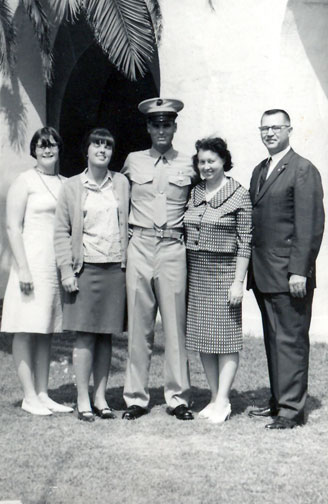
Harlan's USMC portrait


On December 7, 1941, World War II reached the United States when the Japanese made a surprise attack on the naval base at Pearl Harbor, Hawaii. Young American men enlisted by the thousands to do their part for their country. One of these men was Harlan Geyer. As part of the 2nd Marine Division, Harlan served in three major battles of the Pacific Campaign, Tarawa atoll, Saipan and Tinian.


Harlan and friends


I had a group of radio operators, a group of telephone alignment switchmen, and some message center people, you know, 20 or 30 guys were reporting to me. [They'd] string lines and set up switchboard, operated portable radios. Most of the communicators were [not on the front lines] well, there’s communicators on the front line too, but actually I was in a shore party battalion, mainly they set up on the beach. We weren’t inland fighting the enemy. We come under fire when we landed at Saipan because, you know, the enemy wasn’t that far ahead. And one of my men was killed by a mortar.


After the war, he was ready to settle down and start a family. It took him four proposals to four different girls, but eventually he found the right one, his good friend Ila Bear. They were married June 11, 1945 in Camp Lejeune, North Carolina by Navy Chaplain Harold B. Lawson. The ceremony was witnessed by their friends Dorothy Harloff and William Marshall.

Harlan looked for work in Moline, Illinois, interviewing for a job at the telephone company, but they wanted him to start out at the bottom of the ladder. This didn't sit well with Harlan, who felt he deserved credit for the four years of wartime communications experience under his belt. Dismayed at his prospects in the civilian workforce, Harlan decided he would make his career as a Marine. For their first year of marriage, Ila lived with her brother John in Moline, where she taught elementary school, while Harlan was sent to school in Missouri. Harlan was soon after stationed at Camp Pendleton and Ila moved with him to Oceanside, California, where they had two children, Harlan Jr. and Cherie.


Harlan Sr, Ila, Harlan Jr and Cherie at Harlan's graduation ceremony in 1957


While serving as the supply chief of Base Communications at Camp Pendleton, Harlan went back to school, earning an Associate of Arts degree from Oceanside-Carlsbad College in 1957. My father, Harlan Jr, would tell us that his main memory of his father was of Harlan Sr studying at his desk in the back room of the house.


Harlan and Ila with Christina


Harlan Sr and Ila were devoted grandparents. After Harlan Jr married and moved to Virginia in 1978, Harlan Sr and Ila decided to move as well, living for several years with Harlan Jr's family in Oak Hill. But as the family grew, the house got crowded and Harlan and Ila moved first to a townhouse in Chantilly, then to a ranch-style house in Herndon. Us grandchildren often spent the weekends at their home, my youngest brother Christian lived with them for some time so he could attend the school near their home.

In 1992, after fighting for years against aggressive breast cancer, Ila passed away. Harlan joined a widowers club where he met Mary Bahlmann, who soon became his second wife. Harlan and Mary were active in Civitan and the local bridge club. Harlan often taught craft workshops at the local senior center.

They lived happily for many years, until 2001, which ended up being a very tough year for Harlan. Mary had a recurrence of colon cancer and his son, Harlan Jr, was diagnosed with pancreatic cancer. Both passed away during the course of the year.


Harlan and Mary Geyer


Harlan stepped into the role of father for us grandchildren. Having breakfast at the Reston Silver Diner with his grandsons every Saturday, where even the waitstaff knew him as "Grandpa", and travelling all the way to Berlin, Germany to walk me down the aisle at my wedding in 2003.


Harlan escorting Christina down the aisle at her wedding, 24 May 2003


At the end of 2005, Harlan was diagnosed with esophageal cancer. He passed away on March 24, 2006 at the age of 85.


-----------------------------------------

Harlan Martin Geyer, Sr. (Age 85) of Reston, Virginia, died on Friday, March 24, 2006 at Fair Oaks Hospital after a four month battle with esophageal cancer. He was born July 20, 1920 in the town of Wellman, Iowa, to the late Francis Grant and Grace McGimpsey Geyer.

Harlan served 20 years in the US Marine Corps, attaining the rank of 1st Sergeant. As a member of the 2nd Marine Division, he took part in the Battle of Tarawa, one of the bloodiest battle of the Pacific in World War II. He also served in the Battles of Saipan and Tinian.

On June 11, 1945, he was joined in marriage to Ila I. Bear. After her passing in 1992, he was united in marriage to his second wife, Mary Gallagher Farley Bahlmann, who passed away in 2001. Harlan is survived by three brothers, Calvin, Larry and La Verne; his sisters, Doris Allard, Dorothy Biddle and Niva Nix; his daughter, Cherie Geyer and his grandchildren, Christopher, Christian and Christina Geyer and her husband, Rainer Spang. Harlan also rejoiced in being a loving grandfather to Beth, Patty, Scott and Chris Farley, grandchildren of his second wife. He was preceded in death by his son, Harlan M. Geyer, Jr., of Oak Hill, Virginia.

Funeral services for HARLAN M. GEYER will be held at 10 a.m. Saturday, April 1 at ADAMS-GREEN FUNERAL HOME, 721 Elden St., Herndon, VA.
Burial will be at Arlington National Cemetery on Tuesday, April 11 at 10 a.m. Relatives and friends are welcome.

Written by Christina Geyer, an abbreviated version appeared in The Washington Post on March 29, 2006.


Harlan's burial ceremony at Arlington, 11 April 2006

Friday, June 15, 2007

Fathers of Mine: Harlan Martin Geyer Jr

Harlan as a baby

My father, Harlan Martin Geyer, Jr., was born on May 9, 1947 to Harlan Martin Geyer, Sr., and Ila (Bear) Geyer, at the U.S. Naval Hospital in Oceanside, San Diego, California. He was the oldest of two children born to Harlan and Ila, and the only son. He was always very close with his younger sister Cherie. He died on November 2, 2001.

From the start, he was a caring person and an animal lover. He was always bringing home stray animals and wild creatures and volunteered with the local church group.


----------------------------------------

Granada Hills - A group of young people of high school and college age, called "SLUPYouth" from the St. Luke Presbyterian Church, 16200 Chatsworth St., Granada Hills, assisted wheelchair and bed patients to attend a Presbyterian worship service at Los Angeles County General Hospital.

Nancy Laich, Rhonda Dale, Marna Muenze and Dawn Buell, Chuck Benyei, Ken Hanson and Harlan Geyer Jr., met at the General Hospital for their instructions.

The young people were assigned to patients and given instructions by the hospital staff.

The service was scheduled for one hour after which the patients were returned to the wards. The young people felt that it was an inspiring and rewarding experience to help these people.

Source: "Church Youth Help Hospital Patients at Worship Service," Valley News, Van Nuys, California, 24 June 1966, page 36-A, column 1.

----------------------------------------

Harlan at 18 years old

Sometime during his first year of college, Harlan decided that he needed to serve his country. Over the strenuous objections of his career Marine father, he enlisted in the Marine Corps.

He always told us children that he got in a fist fight with his dad when he told him, but this may have just been him kidding around. From an interview with my grandfather, Harlan M. Geyer, Sr., on November 26, 2005:

Christina: Is it true that when dad came home and said he volunteered for the Marines that you got in a fight and punched him?

Harlan: No I did not punch him, that I know of.

Christina: He always said that you were fighting in the front yard and you punched him.

Harlan: I don’t remember that, I just…

Cherie: I remember him crying.

Harlan: I was just upset because I figured that I did enough for both of us and when I became convinced that he was determined to go into the Marine Corps, I realized that I had to make a change and I said okay, if you’ve gotta go, I’m taking the day off and I’ll take you down myself. So I took him. And when the recruiting sergeant called me, wanted to talk to me, and I told him to go to hell. And he said that he was supposed to pick him up at 5 o’clock in the morning or something like that and I said, well, if you do you’re a dead man. But then Junior come home and he was so uptight about wanting to be a Marine that I decided that the best thing for me to do was to change my attitude and support my son.

Christina: Did he say why he wanted to be a Marine so much?

Harlan: He wanted to be like me.


Harlan after completing boot camp
My aunt Cherie is on the far left and my grandma and grandpa are to the right

Harlan served from 15 June 1966 until 1 March 1969. Over this time period, he was awarded the National Defense Service Medal, the Vietnam Campaign Medal with device, Meritorious Mast, Presidential Unit Citation, Vietnam Service Medal with three stars, Combat Action Ribbon and the Good Conduct Medal. His combat history included counterinsurgency operations and participation in the operations De Soto, Kentucky, Osceola, Lancaster, Dye Marker, Scotland and Napoleon. He was a member of HMM-163, MAG-36, 1stMAW.

----------------------------------------

A Marine rifle company in Vietnam will shortly display a California State Flag through the efforts of State Sen. Tom Carrell of San Fernando.

The flag was sent to Marine Pfc. Harlan Geyer, a Mission Hills resident, at the request of his mother, Mrs. Harlan M. Geyer, Sr., 10882 Arleta Ave., who wrote to the Senator and told him that her son, a native Californian, had requested one.

Accompanying the flag, Sen. Carrell sent a certificate attesting to the fact that the flag has been flown over the State Capitol in Sacramento.

In a cover letter to the Marine, the San Fernando Valley solon declared, "We will be proud to have it flown over your company in Vietnam."

Source: State Flag Sent to Valley Marine on Vietnam Duty, Valley News, Van Nuys, California, 9 Apr 1967, page 2-A, column 5.

----------------------------------------

After the Marines, Harlan finished college, getting a degree in Accounting, and began working as an Auditor for the Department of Defense Inspector General's Office. As part of his job, he spent long periods overseas investigating the books of U.S. military bases around the world. In 1973, he was sent to investigate a base in Thailand and was assigned to work with a beautiful Thai bookkeeper, my mother, Unchalee.

My mom and dad in Thailand

They married in Bangkok on 10 June 1974, and had a second ceremony on 18 June 1974 at the Candlelight Wedding Chapel in Las Vegas, Nevada. About nine months later, I was born and was always Daddy's Girl. Three and six years later, respectively, my brothers Christopher and Christian were born.

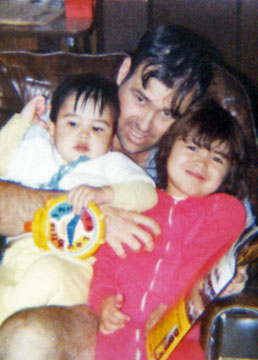
My brother Christopher and I with dad

My dad was my best friend and I still miss him a lot, especially our long talks. He totally got me and at least for me, finding someone who gets you is a big deal. He was an avid gardener and loved clematises, planting them wherever he could. The yard in Virginia was filled with bird feeders and bird baths, he even put dog food out in the woods for the local foxes (whether or not this was a good idea, I don't know, but the neighbors have taken up doing it now).

The proud papa at Christopher's high school graduation
L to R: Christian, Harlan, Christopher, Christina and Unchalee

He read everything he could get his hands on, even the first three Harry Potter novels, and was a WWII history buff. His basement office was filled from floor to ceiling with tank, plane, and battleship models he planned to build after retirement. He was the undisputed, undefeated family trivial pursuit champion. None of us had any chance to beat him, even when we all played together against him (I've since taken the role of champion on).

After a 10 month fight against pancreatic cancer, he died at the age of 54. He never got to see me get married or know that Rainer is the guy that I'd end up with. I never got to hear the excitement he would have had to know that I'm now pregnant with his first grandchild. But at least I got the time with him that I did. I often have to remind myself that some people never get to know their dads.

My dad loved his garden and fish pond

He did meet Rainer once, however. The summer before he passed away, Rainer came up for a family dinner. He brought a bottle of good Riesling, and although my dad hadn't had any appetite for months, he ate the dinner and drank a glass of wine. I really wish Rainer had been able to get to know my dad better, cause I think my dad was a pretty special guy. You could always depend on him for whatever you needed, whether it was a laugh when you were sad, a talk when you were lonely, or being picked up from college in the middle of the night cause you were homesick.

People may have wondered why I never wrote anything for the 5th anniversary of September 11. That was because I spent most of the day on the phone with my dad, so my memory of 9-11 is tied to the memory of my dad, and it's still tough for me to think about. He worked in a building across the parking lot from the Pentagon. Although he'd been home for months, sick from cancer, he worried that some of his friends might have been in the section destroyed by the terrorists. He stayed on the phone much of the morning making sure that his people were all okay. It ends up that one very old friend of his was in the Pentagon, but luckily not in the affected section. He also comforted his secretary. Her aunt was a secretary in the section hit. After a few worried hours, they found out that she was not in her office at the time and survived unscathed.

Harlan entered the Hospice of Northern Virginia the night before he died. The hospice staff told us that no one had ever had as many visitors as my dad. He was loved by everyone who knew him and his friends and coworkers made a constant stream of visitors on his last day. They told us that the secretaries had worked out a visiting schedule and people came over from his office and the Pentagon in carloads of five and six at a time to say goodbye. I remember standing outside his room and crying with dozens of his male and female coworkers alike. I don't know why, but it's unbelievably heartbreaking to see 50 year old men, many of them former or current military men, breaking down into sobs.

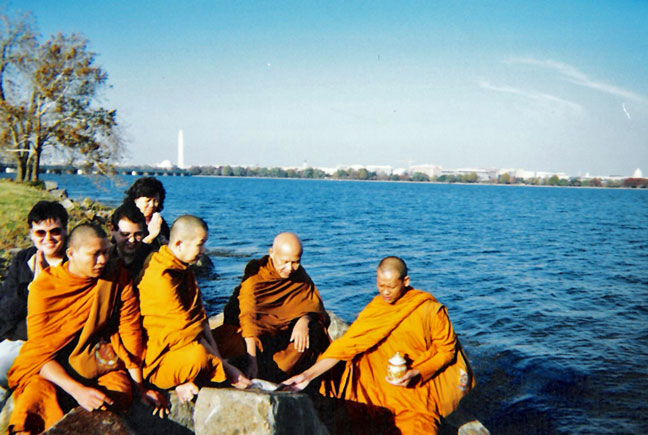
We spread some of his ashes at the Tidal Basin

On that last day, he was also presented with the Distinguished Civilian Service Award. It is the highest civilian honor the Defense Department awards. He stayed aware of what was going on almost to the very end and was very proud when they came for the ceremony.

He died in the evening with his family surrounding him. I was holding his hand.

Some of his ashes are interred at the Columbarium in Arlington National Cemetery

----------------------------------------

Harlan M. Geyer Jr. - Of Oak Hill, VA. On Friday, November 2, 2001 at Hospice of Arlington. Beloved husband of Unchalee Geyer; father of Christina Lynn Geyer of Durham, NC, Christopher Eugene and Christian Alan Geyer, both of Richmond, VA; son of Harlan M. Geyer of Reston, VA; brother of Cherie Ann Geyer of Aliso Viejo, CA. Mr. Geyer was a Marine Combat Veteran of Vietnam and awarded the Distinguished Civilian Service Award. Service will be held on Sunday, November 4 at 1:30 p.m. until 4:30 p.m. at ADAMS-GREEN FUNERAL HOME, 721 Elden St, Herndon, VA. A graveside service will also be held at Arlington National Cemetery Columbarium on Tuesday, November 20 at 1 p.m. (Please assemble at 12:30 p.m. at the Administration Building). In lieu of flowers, memorials may be made in his name to Hospice of Northern Virginia or the American Cancer Society.

Source: Harlan M. Geyer, Jr., obituary, The Washington Post, 3 Nov 2001.


----------------------------------------

Harlan Martin Geyer, Jr.
Sgt USMC
9 May 1947 - 2 Nov 2001

Monday, May 21, 2007

Carnival of Genealogy, 24th edition

I'm a little late in spreading the news, but the 24th Carnival of Genealogy is now posted over at Creative Gene:

The topic for this edition is Mothers! We have wonderful tributes and tales of the women who have for better or worse had a hand (or a gene ;-) in making us who we are today. They come in all shapes and sizes, races and religions, ages and eras. They live in our hearts and in our minds and now in our Carnival too. Let's hear it for moms!

[...]

The topic for the next edition of the COG will be: Who inherited the Creative Gene in your family? We're all aware of someone on the family tree who was/is "the creative one" or "the talented one"... the painter, musician, poet, wood carver, interior designer, writer, knitter, singer, calligrapher, or such. Tell us about their creative pursuits. Let's hear it for the creatives! Please submit your blog article to the next edition of Carnival of Genealogy using our
carnival submission form. The deadline for submissions for the next edition will be June 1st. Past posts and future hosts can be found on our blog carnival index page.

Included in this edition were two articles I wrote, McGimpsey letter from 1854, my transcription of a letter from William and Marget McGimpsey in Ireland to their son Henry in America, and Happy Mother's Day, about my mom.

Sunday, May 13, 2007

Happy Mother's Day

My mother Unchalee Geyer was born in Thonburi, Thailand, just across the Chao Phraya River from Bangkok. Thonburi became a part of the city of Bangkok in 1972. My mother was the sixth of seven daughters born to Sae Lim Iew-Jua and Malee Kasaranukork. Her parents also adopted two sons. My mother identifies herself as Thai, but my grandparents are Thai Chinese, or Chinese immigrants to Thailand. As is common among the Thai Chinese, my grandparents adopted new Thai surnames, so my mother’s family’s surname was chosen by my grandfather to be Umarintarapirom, while Malee’s parents Sae Lau Hui-Kak and Sae Khow Pow-Khim chose the surname Kasaranukork for my grandmother’s family. My grandfather, the son of Sae Lim Chui-Pou and Sil-Houng, passed away when I was a child.

Iew-Jua and Malee had a lingerie shop in Bangkok. On the first floor was the shop, living room and kitchen. The living room was open to the shop and the family would sit, watching television, tagging the clothing, and eating, if there were no customers to help. The second floor held the sewing machines and two bedrooms, one for the parents, the other for the kids, where they slept haphazardly on mattresses spread on the floor. The family was a successful upper-middle class family that valued education and sent several daughters, including my mother, to college.


Part of my Thai family in my grandmother's living room
Left to right on couches: Orachon's husband Eirak, my uncle Sung, my grandma Malee, my mom Unchalee, my aunt Orachon, my aunt Porntip, and my aunt Chitra
On floor: Orachon and Eirak's children (my cousins) Opp and Titiporn


After earning the equivalent of an Associate degree in Bookkeeping, my mother went to work on a U.S. Army base in Bangkok. It was here that she met my father, Harlan Geyer, Jr. My father was an auditor for the Department of Defense Inspector General’s Office, and my mother was assigned to help him with the investigation of the base’s finances.

They began dating, chaperoned by the entire family. My father would take my mother to the movies where she’d sit on one side of a row and he’d sit on the other, with her family taking all the seats in between. After six months of this, her family decided they should marry, which they did on June 10, 1974. She moved to California with my father, her family gave her a plane ticket as her going away present, just in case she didn’t like America, and she soon found herself pregnant with me.


My mom in 1974


Throughout my childhood, I thought I had nothing in common with my mother. We fought much of the time and I don’t think either of us understood where the other was coming from. As I get older, I realize my mother and I actually have quite a lot in common. We both fell in love with foreigners and moved to new countries for love. I know how hard my adjustment to Germany was, which is still a Western country, so I can’t imagine what it would be like to move away from a very large, close knit family in Thailand to the United States. I can imagine that it was a very difficult transition for her. Now that I am pregnant, I also know that I could not have handled pregnancy and the transition at the same time. It must have been a challenge for her.


My mom and my mother-in-law Hildegard Spang at our rehearsal dinner in Berlin


My mother has always supported my move to Germany (how could she not when she did the same thing, right?). I worry that I will end up having the same fights with my children that I had with my mother. When my 15 year old son comes home drunk, will I say things like, “Kids in America aren’t allowed to do that!” and will my son respond, “This isn’t America, mom! Duh!”? I imagine I will come to understand her more and more the longer I live, and especially now as I’m entering motherhood myself.

So, to a very special mom that I appreciate more and more with each passing day, HAPPY MOTHER’S DAY!


The family at my brother Christian's Bahai wedding ceremony
Left to right: my brother Christopher, my mom, my sister-in-law Nosheen, my brother Christian, me, my dad's sister Cherie Geyer, and my cousin Opp

Friday, May 11, 2007

McGimpsey letter from 1854

It's amazing how mothers (and fathers) never change. Even after 153 years, mothers are still offering the same advice and asking the same questions of their far away children (Do you have enough to eat? Are you eating well? Who are your friends?).


William and Marget McGimpsey in 1860


Here is my transcription of a letter sent from William and Marget (Martin) McGimpsey of Loughriescouse, Ireland, to their son Henry James McGimpsey in America (my 3rd great grandfather) on April 2, 1854. I received photocopies of this letter from my aunt Cherie Geyer, who in turn received them from our cousin Vernon Capps, who I believe is in possession of the original. It is difficult to see any punctuation that may be in the original, I have only included punctuation if I thought I saw it. I also have left spelling and capitalization as it appears in the letter, therefore my transcription may be a little difficult to understand. If you have any corrections, questions or anything else you'd like to say, please leave a comment! I'd also like to thank all the people who offered transcription and Irish geography advice to me when I asked for help previously.


Page 1 of the letter


Laughries Caus[1]

Aprile 2th 1854

Dear Son we Recived your letter Dated the 8 of March on the 29th day of Aprile. Thenks be god for his tender Mercies to us and your Letter found us and all your friends and Wellwishers in good health. we have great cause to Bliis[2] the Name of him that is able to save to the very uttermost all that puts their trust in him for his kind Care in perserving us in the midst of danger for Many hundreds Since you left home has found a wattery grave for having an oppertunity of seeing the newspaper of so many Shiprecks we Never thought that we we would a heard fom you and when yang John Moor[3] Came with the letter to your Mother the house was filled with your friends to hear from your. you send your kind love to your grandfather he flitted to my house the Satterday after you left home where he is Now living and doing well. your Mother wants to know if you had plenty of Sea Store please let us know what you are employed at and who you spend the lords day


[1] Loughriescouse is a township in the parish of Newtownards, County Down, Ireland
[2] Bless
[3] Moor and Moore are the same surname in Ireland


Page 2 of the letter


I am happy to kow[4] that you found friends when you arrived in pitsburg put your trust in the Lord for who shall hurt you if you be the follower of that which good. My son Rember the Many advices i gave to you for he that waks[5] With wise Men Shall grow wiser Still but the Companions of fools Shall be Destroyed take care and keep good Company. this is the advice of your tender father which never Might have another oppertunity of addressing you. I would advise you to write to your friends in america and let them both know wher you are and if god wold think fit that you Might fall in with a place for us we wold Sell out and Come to america. you Want to
kow[6] what your brother James is about he is still living at home and working on the farm and wold be glad to see you your friend Thomas Mcgimpsey wishes you to Let his friends kow that his family is all in good health and he has purchased Henery fergisons farm of land. Serd Thompson is Married to Joseph Crake.

[4] know
[5] walks
[6] know

Page 3 of the letter


the old Marques of londonderry[7] is Dead And we have got Lord Castlerea[8] for our Land lord. And I took your your letter to old Mr. John Mcdonalds And he was glad that you had seen his son John and he is in good health at present. Markets is high at present and Meal is Sd 2=2 per Stone and flower Sd 26 per some and potatos .6 per hundred and every thing in perposion lint seed is Raising in prees[9] up till pound five for Rega Barrels your aint[10] McCracke and family is all will and is is doeing well. Let us know know if you agree With the diet of america and if you like it as well as your Mother Contry Robert Patten Sends his kind Love to you and says that he has a great Wont of you on the Satterdays nys to help him in the Shape John McClean Wife and family Sends his kind Love to you and hops to be with you yet

[7] Charles William Stewart, 3rd Marquess of Londonderry (18 May 1778 – 6 March 1854)
[8] Frederick Stewart, Viscount Castlereagh from 1822-1854 when he became 4th Marquess of Londonderry
[9] Price
[10] Aunt


Page 4 of the letter

When you Rite Direct Letters to the Care Mr James Moor Mohill Street grween newtown was Cunty Down Irland for William McGimpsey of Laughries Caus farmer Rite soon as we will be waiting to hear from you. I aid no more at present but I ains as a family sals scribing our selvs till aft Death your father and Mother ----

William and Marget Mcgimpsey


Henry James McGimpsey in 1860

Friday, May 04, 2007

Places named Geyer

On our recent vacation, we happened, mostly by chance, upon two places related to the surname Geyer. First, on our way up to Berlin, we decided to stop in Bamburg for lunch and sightseeing.


Residenzschloss Geyerswörth

First, it was a pleasant surprise to find ourselves driving on a street called Geyerswörth (this translates as something like, "Geyer's Place") as we headed towards the old city center. Then, as we pulled into the parking deck next to the Tourist Information Center, we were greated by a large overhead sign reading "Parkhaus Geyerswörth."

The nearby Schloss Geyerswörth, or Townhall Castle Geyerswoerth, was the home of the well-known Geyer family of Nürnberg (Nuremberg), who settled in Bamberg in the 14th century. In 1580, the palace was taken over by the bishop of Bamberg and over the years, many alterations and renovations have been made, so there is not much left visible of the original home.

Schloss Geyerswörth (Geyerswoerth Palace)

Tourists are encouraged to climb the tower for the view of Bamberg, the keys are available from the Tourist Information Office. The courtyard is often host to concerts (Feierhof Geyerswörth blog - in German/auf Deutsch).

The entrance to the courtyard of Schloss Geyerswörth


Berg und Bingestadt Geyer

A few days later, on our way from Dresden to Karlovy Vary, I noticed a sign that we were entering the Erzgebirge, or Ore Mountains. I remembered from looking up the origin of the name Geyer on Ancestry.de that one possibility was a town of Geyer in the Erzgebirge, so I quickly whipped out the map book and found that the town was almost directly on our route.

That's me at the city limits
(27 weeks pregnant with the next Geyer descendent)


Geyer is a small town of approximately 4,000 residents located about a half hour to the south of the city of Chemnitz in the German state of Saxony. The city is almost completely surrounded by the Geyersche Wald (Geyer Forest). The first mention of Geyer is in 1381, but there was mining going on in this area far earlier. It is from this mining that it has its status as a Bingestadt ("Binge" city). A "binge" (link in German) is a large area of sunken earth created by the collapse of a mine.

Postdistanzsäule (postal distance column)

The postal distance column located in the town square gives the postal delivery time between Geyer and various other cities in the year 1730. For example, the delivery time between Geyer and Leipzig was 24 hours ("St." stands for "Stunden", meaning "hours"). The columns were erected in many Saxon towns on the order of the Saxon Kurfürst (elector) August "Der Starke" (August "the Strong"). The obelisk carries the Saxon-Polish double coat of arms for Kurfürst Friedrich August I of Saxony, who was also King August II of Poland. The posts became obsolete starting in 1840 after a new standard of measurement was developed. Click here for a closer look at the Postdistanzsäule

The Wachturm (watchtower)

The square base of this 42 meter (138 feet) high former military post and watchtower, was built around 1395. The tower's octagonal upper section was added on between 1561 and 1564. It continued to be stocked and kept as a military post and watchtower until 1947. It is now the location of the local history museum. Next to the tower are markers listing the names of soldiers from Geyer who lost their lives in battle. There was no one named Geyer listed on these, and since the surname distribution maps I examined previously also did not show a large concentration of Geyers in this area of Germany, I can only conclude that if this is the origin of some Geyers, they moved out of the area a while back.

The view of Geyer from the base of the watch tower

The visit to Geyer was a bit sad. It is clearly one of the still very run-down towns of the former East Germany that suffers from high unemployment and a lack of money. But renovations have been made to the historic buildings and the town seems to be working hard to advertise the skiing and hiking in the area. For more photos, there is also a nice photo album of the city on it's website (in German/auf Deutsch).

Carnival of Genealogy

It's official...

My last post, Shaping the Future, has been included in the 23rd Edition of the Carnival of Genealogy. The topic was School Days, and there are twenty wonderful submissions for you to check out! The next deadline for submission is May 15th and, in honor of Mother's Day, the topic is Moms. Will you be the next to join the Carnival?

Tuesday, May 01, 2007

Shaping the Future

"Teaching is the only major occupation of man for which we have not yet developed tools that make an average person capable of competence and performance. In teaching we rely on the "naturals," the ones who somehow know how to teach.”

-- Peter F. Drucker

I've had many teachers in my life, primary, middle and high school teachers, instructors, lecturers and college professors, but perhaps the two teachers who have had the greatest impact on my life never taught me in a classroom. They were my grandparents, Harlan and Ila Geyer.

Harlan was born on July 22, 1920 in Lime Creek Township, Washington, Iowa, and was raised just north of Wellman. He was the oldest of twelve children born to Francis Grant and Grace (McGimpsey) Geyer. In 1920, his father was a tenant farmer, working rented land to support his quickly growing family. Life was stressful; they had problems making ends meet for a family that grew with the birth of a child every two years. As Harlan would later put it, "We didn't have much."

But Harlan was a good student and in 1936, he decided to enter the Normal Training Program at Wellman High School. The Normal Training Program was passed into law by the Iowa State Legislature in 1911 and existed as part of the Wellman, Iowa education system between 1927 and 1945. The law included the following section:

"In order to develop an interest in rural life, at least one semester in Agriculture, Domestic Science and Manual Training is given a special place in the course. Two semesters in Pedagogy and one semester in Methods, together with emphasis on Observation and Practice Teaching is the specific professional feature of the Normal Training High School Course."

Deliberately or not, Harlan was following in the footsteps of his uncle Harold Geyer, a Class of 1927 graduate, who was one of Wellman's first Normal Training graduates.

Harlan Geyer, Sr. in 1938 (22 July 1920 - 24 March 2006)


It was strenuous, demanding work, with students sometimes coming to school before classes to study and staying late, often until suppertime, to complete the extra assignments the program required. The curriculum included specialized courses in Education Psychology, School Management, and Methods. Methods, a practical course designed to teach effective lesson development and instill good teaching principles, was especially detested, as can be seen in this parody, written and performed during a Normal Training Club meeting by Wellman Class of 1930 Normal Training graduates J. Paul Yoder and Walter Marner, with assistance from Stanley Eash and Clifford Monroe:

(Tune - "I've Been Working on the Railroad")

Verse 1:
Oh, I was born in Wellman town,
A-workin' on my Methods.
All day long I write the outline down
A-workin' on my Methods.

Chorus:
I've been workin' on my Methods
All the live long day.
I've been workin' on my Methods
To pass the time away.
Don't you hear the school bell ringin'?
Hurry to Room Five!
Get your books and start to workin'
We sure have to strive.

Verse 2:
I hope to teach a country school
If I survive my Methods.
But I will never be so cruel
As to make them work on Methods

Verse 3:
And when I die and go away
Still workin' on my Methods,
I wonder will St. Peter say,
"Do you have your Methods?"


Harlan's Normal Training Certificate


In May 1938, Harlan graduated Wellman High School and along with his diploma, received a Normal Training Certificate. He got a position teaching in a one-room schoolhouse Lookout No. 6, in English River, Washington, Iowa, where he taught for a year. He kept in touch with two of his students, exchanging Christmas cards every year. Here, Harlan describes a visit he made back to Iowa with his second wife, Mary:

We looked up where my old school was. Ila’s old school was more modern and it became a home for somebody because it had running water and electricity, but mine was just way out in the middle of nowhere, so it no longer existed. Well, we went back and seen these kids, the only two of my students that I ever really got contact with were my eighth grader and my kindergartner. The eighth grader, his mother was a widow when he was going to school and when I got in contact with him, the kindergartner, him and his wife were rentin’ my eighth grader’s farm. The eighth grader had built another house on his farm, so actually my kindergartner and my eighth grader still are back in where the school was at, on my eighth grader’s farm. And I hear from them regularly every year and we went to visit them, Mary and I did. So, it’s out in the middle between West Chester, Kalona and Wellman.


Page 1 of Harlan's Teachers Annual Report for Lookout No. 6, English River Township, Washington County, Iowa, May 1939


Between September 5, 1938 and May 5, 1939, Harlan taught eleven students, five boys and six girls. As seen on page 1 of his Teachers Annual Report, he earned $50 a month, putting the approximate average cost of tuition per student per month at $5, a fact that was recorded on the report. The girls' attendance was 97% for the year, while the boys' was 89%. Illa Belle Kauffman, age seven, was able to attend less than 24 weeks of school because of heart trouble, poor health and distance to the school.


Page 2 of Harlan's Teachers Annual Report for Lookout No. 6, English River Township, Washington County, Iowa, May 1939


The school was not in very good condition. As Harlan stated before, they had no electricity or running water. On page 2 of the report, he rates the condition of the girls' outhouse and the fuel house as poor and states that the most urgent needs of the school are better out-buildings, a new blackboard and a more sanitary drinking fountain.

Harlan gave instruction in American citizenship, physiology and hygiene with special reference to stimulants and narcotics, elements of vocal music, fifty minutes of physical education a week, the Constitution of the U.S. and of Iowa, and the history of Iowa. Volunteers managed to raise $7.41 for the school at the Christmas Program, with the money left in the charge of the School Treasurer. The report asks if the American flag was displayed regularly, it was until "lately", when the rope broke.


Page 3 of Harlan's Teachers Annual Report for Lookout No. 6, English River Township, Washington County, Iowa, May 1939

Page 3 of the report gives the students' names and marks. Enrolled in his class were: Glada L. Hollcraft, Harold Horak, Merle Venzke, Robert Scott, Darlene Venzke, Rosetta Vodicka, Harald Mass, Viola Kauffman, Edna Hoover, Leota Hoover, and Allan Stransky. All advanced to the next grade level.

Soon after he started teaching, he became friends with his future wife, Ila Bear. Harlan describes their first encounter:

Probably the first time I met her was at the teacher’s meeting. She was teaching in Washington County. There was Orville Hradek and Arvid Wagamon and I, and we were sitting behind these girls and we just wanted to tease them and I guess I stuck a pin in Ila, I don’t remember that much about it. It’s just one of the things to do when you’re a kid. I was only 18.


Ila Bear (11 June 1913 - 13 March 1992)


Ila Iola Bear was born on June 11, 1913 in Johns, Appanoose, Iowa, the daughter of Samuel Lewis and Bessie Belle (Ginkens) Bear. Her father, Samuel, was a farmer and an outstanding carpenter, who died in 1939 after his horses bolted, causing him to fall from the hay wagon, which resulted in two crushed neck vertebrae. Her mother Bessie was a school teacher before marriage.

As long as her younger brother John could remember, Ila wanted to be a school teacher as well. She graduated from Seymour High School in Wayne County, Iowa on May 12, 1932. Perhaps she wasn't the most studious girl there, in her junior year high school yearbook, her initials I.I.B. are jokingly said to stand for "Interested In Boys."

On September 9, 1935, Ila entered the Iowa State Teachers College in Cedar Falls, Iowa, now the University of Northern Iowa. A brief history from their website:

The College of Education is the oldest department on campus; in fact, UNI began as a teacher preparation school in 1876. The university was renamed the Iowa State Teachers College in 1909, and the State College of Iowa in 1961. Not until that year did the college allow its students to graduate without completing the teacher preparation sequence.

Ila's Admission to Iowa State Teachers College,
November 22, 1935

Her brother, John Bear, remembers when he and their brother Claude Bear dropped Ila off for school:

Ila went to Cedar Falls Teacher, in order to be a teacher, you know. I remember Claude and I took her up there to get enrolled and she told us to drive by the women’s dorm and honk our horn and all the women come out and looked out the windows. Another thing I’ll tell you, from southern Iowa up to Cedar Falls have a different accent and they made fun of her cause she had kind of a southern accent. And she got even with them. You heard of hedge balls?

They call them Osage-oranges. They grow pretty big and they’re green and they’re rough outside and then what they have inside is kind of like a milky stuff that’s sticky. But you get them and put them in your basement and you won’t have any spiders. Spiders don’t like 'em. But that’s how she got even with some of them girls up there for teasin' her cause she had that accent. They thought you could eat 'em and everything. They’d kill you if you ate 'em. They’re poison. She took some of 'em up there to them. Some of 'em thought that they could bite 'em. She had to stop them.

Peace must have been declared at this point, as Ila's signature book from her time at ISTC is full of poems and sentiments of friendship from her fellow students. Incidentally, Osage-oranges, also known as hedge-apples, are apparently not strongly poisonous, causing only mild vomiting when eaten (link), and have not been clinically proven to deter pests (link).


Ila's Iowa State Teachers College Transcript


At ISTC, Ila took classes in composition & rhetoric, English literature, American literature, grammar, medieval and modern history, US history, civics, economics, algebra, plane geometry, agriculture, general science, physics, physiology, physiography, arithmetic, home economics, pedagogy, and psychology.

After two semesters of instruction, Ila was ready for a teaching position, completing her ISTC coursework during summer sessions. During the 1936-1937 school year, she was the teacher at Brushy No. 3 in Walnut Township, Wayne, Iowa. She spent two years, from Sept 1938 to May 1940, at Union Rural School in Lime Creek Township, Washington, Iowa, which, in 1940, was considered one of the best, most well-equipped rural schools in Washington County.

From September 1940 to May 1941, she was an elementary grades teacher at Huron School, Burlington, Des Moines, Iowa. She taught elementary school at Fort Byron, Illinois from 1941 to 1942, and from September 1942 until June 1946, she taught elementary grades in East Moline, Illinois. On October 20, 1943, she graduated from ISTC with a Bachelor of Arts in Elementary Education.

She corresponded regularly with her old friend Harlan and after he returned from service in the Pacific, he proposed. They married on June 11, 1945 in Camp LeJeune, North Carolina. Afterwards, she returned to East Moline, where she lived with her brother John, while the US Marine Corp sent Harlan to school in Missouri. According to both John and Harlan, she was the first school teacher in East Moline that was allowed to continue teaching after marriage. Up till that time, women were expected to retire to their homes to raise their families upon marriage.


Harlan and Ila Geyer


In 1947, they moved to California, where Harlan was stationed at Camp Pendleton. That year, Ila gave birth to my father, Harlan Geyer, Jr., known by family and friends as Jr., and she changed careers to become a stay-at-home mom. My aunt Cherie remembers:

Jr. had trouble learning when he was young. I can remember sitting on the little brown wooden chair while she tutored Jr. and Joey Tudor in reading (with the Dick and Jane books). Maybe he was 7 or 8, and I was 3 or 4. She's why I excelled in school. She's also the reason I developed my love for reading. They both loved to teach and all the time I was in school I was going to grow up and be a teacher like my parents. My mom taught me that a girl always had to have an education and a profession that she could fall back on if something ever happened to her husband. Teaching offered that.

I remember being taught to read by my grandmother even before going off to school. I'd sit on her lap, reading out of ancient, dog-eared Dick and Jane readers, I expect that they're the same ones she taught my father out of. She and my grandfather volunteered at my elementary school, Floris Elementary, throughout my years there, touching the lives of children of still another generation.

My grandmother died on March 13, 1992, after several long years of fighting cancer. She provided me with one last lesson; she was the first difficult loss of my life. Although it was a hard lesson that I didn't want to learn at the time, my grandfather taught me about acceptance and moving on, remarrying a wonderful, very loving and kind woman, Mary. After the passing of both Mary and his son, Harlan Jr., in 2001, my grandfather stepped up to fill the role of father for my siblings and I, even making the long 12 hour flight from Washington DC to Berlin, Germany in 2003, at the ripe old age of 83, to escort me down the aisle at my wedding. He passed away last year, on March 24, 2006.

Selected sources:

[1] "Normal Training Program" in Wellman, Iowa Centennial 1879-1979, Wellman Centennial Committee (Wellman, Iowa, 1979), 178-181.

[2] Interview with Harlan Geyer, Sr. (Reston, VA), by author, 26 November 2005. Mr. Geyer is now deceased.

[3] Washington County Rural Schools, IaGenWeb, Washington County, online <http://www.rootsweb.com/~iawashin/schools.htm>. Previously published in hard copy: "Rural Schools of Washington County - 1983, Lime Creek Township," Washington County Genealogical Society Newsletter 19 (June 2002): 9-10, 6; originally published 1940-1941.

[4] Interview with John Bear (Aurora, MO), by author, 5 January 2006, in Reston, VA.

[5] E-mail messages from Cherie Geyer to author, 1-2 May 2007.

[6] "Papers of Harlan and Ila (Bear) Geyer," (1932-2006); owned by their daughter, Cherie Geyer; electronic copy in possession of author.

  © Blogger template 'Isolation' by Ourblogtemplates.com 2008

Back to TOP